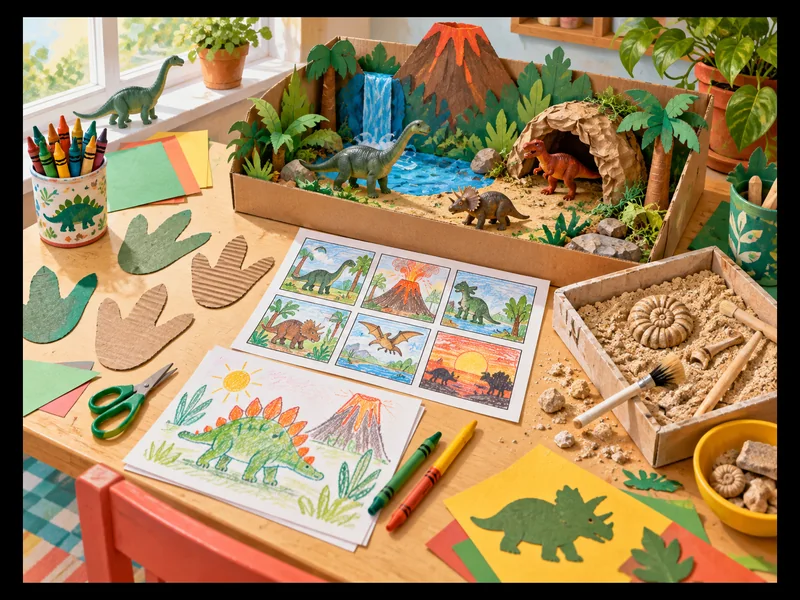
Quick answer: For a screen-free dinosaur afternoon, try a sand fossil dig, a chalk scale walk, a giant footprint trail, an ice excavation, a baking soda volcano, a dinosaur movement game, a design-a-dinosaur challenge and a wordless comic. All eight use paper, household items or a few cheap supplies.
You don't need a big shopping list for a great dinosaur afternoon. These eight activities use things most homes already have, take about 15 to 30 minutes each, and sneak in real science. Pick two or three, or string them together into a full afternoon.
Facts for these activities come from our guide to 10 fascinating dinosaurs for kids, so keep it handy.
1. Sand fossil dig
Time: 20 to 30 minutes | Mess: medium
You need: a shallow tub or baking tray, sand, dry oatmeal or flour, toy dinosaurs or dried pasta "bones," a paintbrush and a spoon.
Do it: Bury the toys and bones in the tub. Kids uncover them gently with the brush and spoon, then sort and name what they find.
The science: Paleontologists work slowly with brushes and small tools so they don't break fragile fossils. Real fossils are bones and teeth that turned to rock over a very long time.
Safety: Small toys and pasta are choking hazards for children under three, so supervise closely.
2. Dinosaur scale walk
Time: 15 to 20 minutes | Mess: none
You need: sidewalk chalk, or string or masking tape, and a tape measure.
Do it: Mark these lengths in a line: T. rex 40 ft (12 m), Triceratops 30 ft (9 m), Velociraptor 6 ft (1.8 m). Walk each one heel to toe and count your steps. How many kid-lengths fit inside T. rex?
The science: Comparing sizes with familiar things, such as steps and body lengths, is how scientists and museums help us picture animals that no longer exist.
3. Giant footprint trail
Time: 20 minutes | Mess: low
You need: big sheets of paper, scissors, tape.
Do it: Cut huge three-toed footprints (some of the biggest meat-eating dinosaur footprints are over 2 ft, or 60 cm, long) and tape a trail across the floor. Kids follow it and guess: Was the dinosaur big or small? Walking or running?
The science: Fossil footprints and trackways help scientists work out how dinosaurs moved and sometimes whether they traveled in groups.
4. Ice excavation
Time: 20 to 30 minutes (plus overnight freezing) | Mess: wet
You need: a plastic tub, small toy dinosaurs, water, salt, a spoon, and a dropper or warm (not hot) tap water in a cup.
Do it: The night before, freeze the toys in a tub of water. Next day, kids "rescue" them by sprinkling salt and dripping warm water on the ice.
The science: Salt lowers the temperature at which ice melts, so it helps the ice break down faster. Real excavations also need patience.
5. Baking soda volcano
Time: 15 minutes | Mess: medium
You need: a cup, a tray, baking soda, vinegar, a drop of dish soap and red food coloring; clay or dirt to build a mountain (optional).
Do it: Put 2 tablespoons of baking soda in the cup, add the soap and coloring, and pour in vinegar to erupt.
The science: Baking soda and vinegar react to make carbon dioxide gas, which makes the foam. The Earth of the dinosaurs had active volcanoes too.
Safety: Keep vinegar away from eyes.
6. Move like a dinosaur
Time: 10 to 15 minutes | Mess: none
You need: open space.
Do it: Call out a dinosaur and everyone moves like it: stomp slowly like Brachiosaurus, dash like Velociraptor, swing your hips and "tail" like Ankylosaurus, honk like Parasaurolophus. Turn it into freeze dance by pausing the music.
The science: An animal's body shape shapes how it moves. Long legs and light bodies run fast; heavy bodies and thick legs move slowly.
7. Design-a-dinosaur
Time: 20 to 30 minutes | Mess: low
You need: paper, pencils, crayons.
Do it: Kids draw a brand-new dinosaur and decide three things: where it lives, what it eats, and how it defends itself. Then they explain why each feature helps. Why plates? Why a crest? Why a long neck?
The science: Real dinosaurs' horns, crests, plates and tails all had jobs. Explaining features is how scientists think about fossils.
8. Wordless dinosaur comic
Time: 20 to 30 minutes | Mess: none
You need: paper, a pencil, crayons or markers.
Do it: Fold the paper into six boxes. Kids tell a story in pictures only, such as "the great egg escape," then swap comics and tell each other's stories aloud.
The science: Storytelling helps kids remember facts, and telling a story without words means paying attention to detail.
Make it a rainy-day plan
| Time | Activity |
|---|---|
| 0:00 to 0:20 | Read 10 fascinating dinosaurs for kids together |
| 0:20 to 0:50 | Sand fossil dig |
| 0:50 to 1:10 | Dinosaur scale walk (outside if possible) |
| 1:10 to 1:25 | Move like a dinosaur |
| 1:25 to 1:55 | Design-a-dinosaur or wordless comic |
Tips for a smoother afternoon
- Set up one activity before starting, so kids aren't waiting.
- Let kids lead. The best questions start with "What do you think…?"
- Put a sheet or old towel under messy trays.
- Keep small parts away from very young children and supervise every activity.
Keep exploring
- Choosing a book? Read How to Choose a Dinosaur Coloring Book.
- Prefer the ocean? Try Ocean Activities for Kids.
Color along with our dinosaur book
Meet 30 baby dinosaurs through detailed coloring scenes and six wordless prehistoric comics.
View Dinosaur Coloring Book on AmazonAbout Rainy Sunday
Rainy Sunday Book Store creates imaginative coloring and activity books that pair curiosity with creative, screen-free time.