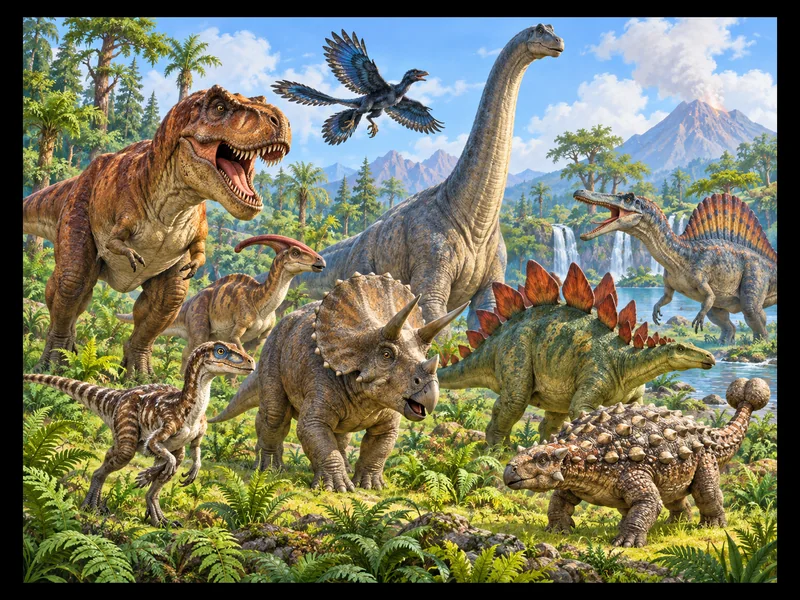
Quick answer: Ten dinosaurs kids love: Tyrannosaurus rex, Triceratops, Stegosaurus, Velociraptor, Brachiosaurus, Ankylosaurus, Spinosaurus, Parasaurolophus, Pachycephalosaurus and Microraptor. They lived at different times across roughly 90 million years, ate different foods and had very different bodies.
Dinosaurs have fascinated kids for generations. Part of the fun is the variety. Some were as long as a bus, some were smaller than a turkey. Some had horns, plates, crests, or feathers.
Here are ten to know, from familiar favorites to a few surprising specialists. For each, you'll find when it lived, how big it was, what it ate and one fact to share at dinner. (Sizes are estimates, and scientists update them as new fossils are found.)
When did they live?
Dinosaurs lived in the Mesozoic Era, which is divided into three periods. The last non-bird dinosaurs died out about 66 million years ago.
| Period | Roughly when | Dinosaurs in this guide |
|---|---|---|
| Triassic | 252 to 201 million years ago | None (dinosaurs were just beginning) |
| Jurassic | 201 to 145 million years ago | Stegosaurus, Brachiosaurus |
| Early Cretaceous | 145 to 100 million years ago | Microraptor |
| Late Cretaceous | 100 to 66 million years ago | Spinosaurus (about 99 to 93), Velociraptor, Parasaurolophus, Triceratops, Ankylosaurus, Pachycephalosaurus, Tyrannosaurus rex |
Mind-bending fact: Stegosaurus lived more than 80 million years before T. rex. T. rex lived closer in time to us than to Stegosaurus.
1. Tyrannosaurus rex (tie-RAN-oh-SAWR-us rex)
Lived: Late Cretaceous, North America | Size: up to about 40 ft (12 m) long | Diet: meat
T. rex was one of the largest meat-eating land animals ever, weighing several tons. It had a huge skull, powerful jaws and teeth up to about 12 in (30 cm) long including the root. Its arms were only about 3 ft (1 m) long, but they were strong. Fun fact: T. rex had a very strong bite, powerful enough to crunch through bone.
2. Triceratops (try-SAIR-uh-tops)
Lived: Late Cretaceous, North America | Size: about 30 ft (9 m) long | Diet: plants
The name means "three-horned face." It had two long brow horns, a shorter nose horn and a big bony frill behind its head. It also had a beak for snipping plants. Scientists think the horns and frill were used for display and possibly for defense. Fun fact: Triceratops and T. rex lived in the same places and at the same time.
3. Stegosaurus (STEG-oh-SAWR-us)
Lived: Late Jurassic, North America | Size: about 30 ft (9 m) long | Diet: plants
Stegosaurus had a row of large, upright plates along its back and four spikes on its tail. Scientists still debate what the plates were for: display, temperature control, or both. Fun fact: Its head was small compared with the rest of its body, so its brain was small too.
4. Velociraptor (vuh-LOSS-ih-RAP-tor)
Lived: Late Cretaceous, Mongolia and China | Size: about 6 ft (1.8 m) long | Diet: meat
The real Velociraptor was much smaller than its movie version, about as tall as a large turkey at the hip. Fossils show it had feather-like coverings, and it had a curved claw of about 3 in (7 cm) on each foot. Fun fact: Scientists have found quill knobs on a Velociraptor arm bone, the spots where feathers attached.
5. Brachiosaurus (BRAK-ee-oh-SAWR-us)
Lived: Late Jurassic, North America | Size: roughly 60 to 75 ft (18 to 23 m) long | Diet: plants
Brachiosaurus was a long-necked giant, standing about as tall as a four-story building when it stretched its neck up. Its front legs were longer than its back legs, so its body sloped like a giraffe's. The name means "arm lizard." Fun fact: It needed to eat huge amounts of leaves every day to fuel its enormous body.
6. Ankylosaurus (ANG-kih-loh-SAWR-us)
Lived: Late Cretaceous, North America | Size: about 20 to 26 ft (6 to 8 m) long | Diet: plants
Ankylosaurus was a walking fortress, covered in bony plates and spikes. Its tail ended in a heavy club made of fused bone that could deliver a hard blow. Fun fact: It was low and wide, which made it hard for predators to flip over.
7. Spinosaurus (SPY-noh-SAWR-us)
Lived: Late Cretaceous, North Africa | Size: possibly about 45 ft (14 m) long | Diet: mostly fish, probably
Spinosaurus may have been the longest meat-eating dinosaur. It had a tall sail on its back and a long, crocodile-like snout with cone-shaped teeth, well suited to catching fish. Recent studies suggest a paddle-shaped tail, though scientists still debate how much time it spent in the water. Fun fact: Most dinosaurs lived on land, so a fish-hunting dinosaur is unusual.
8. Parasaurolophus (PAIR-uh-SAWR-oh-LOH-fus)
Lived: Late Cretaceous, North America | Size: about 31 ft (9.5 m) long | Diet: plants
This duck-billed dinosaur had a long, hollow, curved crest on its head, up to about 5 ft (1.5 m) long. Scientists think air moved through the crest's tubes, letting it make low, trumpet-like sounds. Fun fact: Computer models of the crest suggest it sounded a bit like a trombone.
9. Pachycephalosaurus (PAK-ee-SEF-uh-loh-SAWR-us)
Lived: Late Cretaceous, North America | Size: about 15 ft (4.5 m) long | Diet: probably plants, maybe some small animals
The name means "thick-headed lizard." Its skull had a dome of solid bone up to about 10 in (25 cm) thick, ringed with bony knobs. Scientists debate whether it butted heads, butted sides, or mostly used the dome to show off. Fun fact: Nobody has found a complete skeleton, so much of what we know comes from its tough skull.
10. Microraptor (MY-kroh-RAP-tor)
Lived: Early Cretaceous, China | Size: about 3 ft (1 m) long | Diet: small animals, probably
Microraptor was small, with feathers on its arms and on its legs, so it had four wings. Scientists have studied its feathers and think they were glossy black. It could probably glide, and whether it could truly fly is still debated. Fun fact: Microraptor fossils helped convince scientists that many dinosaurs had feathers.
Are dinosaurs still around?
Yes, in a way. Scientists agree that birds are living dinosaurs. When you see a pigeon or a sparrow, you are looking at a distant cousin of T. rex.
How do we know all this?
Scientists called paleontologists study fossils, which are bones, teeth, footprints and other traces preserved in rock. New discoveries keep changing the picture, which is why dinosaurs today look different from the ones in older books: more feathers, less tail-dragging, and more surprises.
Keep exploring
- Turn the facts into play with Dinosaur Activities for Kids: A Screen-Free Afternoon.
- Choosing a book? Read How to Choose a Dinosaur Coloring Book.
- Prefer the ocean? Take the tour in Ocean Animals for Kids: A Journey Through Six Habitats.
Sources and further reading
Smithsonian National Museum of Natural History (naturalhistory.si.edu), American Museum of Natural History (amnh.org), Natural History Museum, London (nhm.ac.uk), US National Park Service paleontology pages (nps.gov).
Color along with our dinosaur book
Meet 30 baby dinosaurs through detailed coloring scenes and six wordless prehistoric comics.
View Dinosaur Coloring Book on AmazonAbout Rainy Sunday
Rainy Sunday Book Store creates imaginative coloring and activity books that pair curiosity with creative, screen-free time.