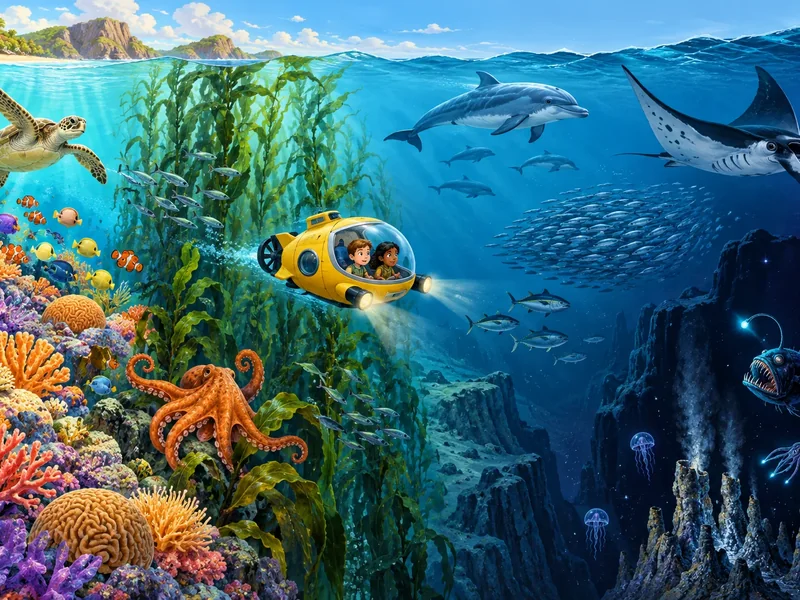
Quick answer: The ocean has six habitats that kids can explore: rocky shores and tide pools, coral reefs, kelp forests, the open ocean, icy polar seas and the deep sea. Each one is so different that its animals need very different survival tricks, from clamping onto rocks to making their own light.
The ocean covers about 70% of Earth, but it is not one big bathtub. Think of it as six very different neighborhoods. On one street the water is warm, bright and crowded. On another it is freezing. On another it is so dark that the animals carry their own flashlights.
This guide takes a tour, one habitat at a time. At each stop you'll meet a few animals, learn the one survival trick that matters most there, and find something to try. Use it for homework help, a read-aloud on a rainy day, or to prepare for a visit to an aquarium or tide pool.
The six habitats at a glance
| Habitat | Where you'll find it | Animals to meet | The big challenge | Survival trick |
|---|---|---|---|---|
| Shore and tide pools | Rocky coasts where tides rise and fall | Sea stars, hermit crabs, sea anemones, limpets | Being underwater, then in open air, twice a day | Clamp down and close up |
| Coral reef | Warm, shallow, clear water | Clownfish, parrotfish, octopuses, sea turtles | Crowding: lots of animals, limited space | Specialize and camouflage |
| Kelp forest | Cool coastal waters | Sea otters, sea urchins, garibaldi, harbor seals | Waves and currents | Anchor, float, wrap up |
| Open ocean | Far from shore, near the surface | Blue whales, tuna, flying fish, leatherback turtles | Nowhere to hide | Speed, schools and countershading |
| Icy seas | Arctic and Antarctic waters | Emperor penguins, walruses, narwhals, leopard seals | Extreme cold | Blubber, antifreeze and huddling |
| Deep sea | Below about 650 ft (200 m) | Anglerfish, giant squid, dumbo octopuses, lanternfish | Darkness, cold and crushing pressure | Make your own light |
1. The shore: tide pools and rocky coasts
Twice a day the tide goes out and leaves rocky shores exposed. Tide pools, pockets of seawater trapped among the rocks, become tiny ocean homes. Animals here face an odd problem: they must survive being underwater, then baking in sun and air, then getting pounded by waves.
Meet the animals
- Sea stars (often called starfish) glide on hundreds of tiny tube feet. Many kinds can regrow a lost arm.
- Limpets are cone-shaped snails that clamp tightly to rock when the tide is out, which helps them hold in moisture.
- Hermit crabs borrow empty shells for protection and trade up to a bigger one as they grow.
- Sea anemones look like flowers but are animals. When the water drains away, they pull their tentacles in and close up.
Survival trick: hold on and hold water. Animals on the shore close their shells or bodies to keep from drying out, and grip rock so waves can't carry them away.
Try it: If you visit a tide pool, check the tide times first and go at low tide. Walk slowly, look closely and let the animals be. Never pull an animal off a rock.
2. The coral reef
A coral reef is built by tiny animals called coral polyps, which grow hard skeletons of limestone that pile up over many years. Reefs grow in warm, shallow, clear water, because corals partner with tiny algae that need sunlight. Reefs cover less than 1% of the ocean floor, yet about a quarter of all ocean species are thought to live in or around them.
Meet the animals
- Clownfish live safely among an anemone's stinging tentacles, protected by a coating on their skin. The anemone gets a bodyguard and some cleaning services in return.
- Parrotfish have beak-like teeth for scraping algae off coral. Some of what they swallow comes out as fine sand.
- Octopuses have three hearts and can change their color and skin texture in a flash to blend into the reef.
- Sea turtles visit reefs to feed and rest.
Survival trick: specialize. So many animals share a reef that each one has its own job, food or hiding style.
Try it: Look at a photo of a reef and pick one animal. Ask: is its color helping it hide, or helping it stand out?
3. The kelp forest
Kelp is a giant seaweed, a kind of brown algae rather than a plant. In cool, nutrient-rich water, giant kelp can grow as much as about 2 ft (60 cm) in a single day, forming underwater forests along some coasts. A root-like holdfast anchors each strand to the seafloor, and gas-filled bladders lift the fronds toward the light.
Meet the animals
- Sea otters have no blubber. Instead, they have some of the thickest fur of any animal. Otters sometimes wrap themselves in kelp so they don't drift away while they rest.
- Sea urchins are spiny grazers that eat kelp.
- Garibaldi are bright orange fish that patrol the kelp forests off California.
- Harbor seals hunt fish among the fronds and rest on nearby rocks.
Survival trick: work as a team, indirectly. Sea otters eat sea urchins. If there are too few otters, urchin numbers can boom and graze away whole kelp forests. So otters help protect the forest that everyone else lives in.
4. The open ocean
Far from shore, the water is deep blue and there is nothing to hide behind. Animals here rely on speed, on swimming in groups, or on clever coloring.
Meet the animals
- Blue whales are the largest animals known to have ever lived, up to about 98 ft (30 m) long. They eat tiny shrimp-like animals called krill, up to several tons a day in feeding season.
- Tuna are streamlined, powerful swimmers. Some kinds cross entire oceans.
- Flying fish leap out of the water and glide above the waves to escape predators.
- Leatherback sea turtles are the largest sea turtles. They dive deep and travel across oceans.
Survival trick: countershading. Many open-ocean animals are dark on top and pale underneath. From above, a dark back blends into deep water. From below, a pale belly blends into the bright surface.
Try it: Color a paper fish dark on top and light underneath. Hold it above your head, then at your feet, and see which view hides it best.
5. The icy seas
The world has two icy ends. The Arctic is an ocean surrounded by land in the north. Antarctica is a continent surrounded by ocean in the south. Penguins live in the Southern Hemisphere and polar bears live in the Arctic, so they never meet in the wild.
Meet the animals
- Emperor penguins are the tallest penguins, standing about 4 ft (1.2 m). Fathers huddle together through the Antarctic winter, and the birds can dive deeper than 1,500 ft (450 m) to hunt.
- Walruses live in the Arctic. They use their tusks to help haul their heavy bodies onto ice.
- Narwhals live in Arctic waters. The "tusk" is really a very long tooth.
- Leopard seals are strong Antarctic predators that hunt penguins and fish.
Survival trick: stay warm inside. Many polar animals have a thick layer of fat called blubber. Some Antarctic fish even have natural antifreeze proteins in their blood so ice crystals don't build up inside them.
Try it: Test blubber for yourself with the "blubber glove" experiment in our ocean activities for kids.
6. The deep sea
Sunlight fades below about 650 ft (200 m). Below about 3,300 ft (1,000 m), none reaches at all, so the deep sea is permanently dark, cold and under enormous pressure. At the very deepest point in the ocean, the water presses down with more than 1,000 times the pressure at the surface. Most of the deep ocean has never been seen by people.
Meet the animals
- Anglerfish dangle a glowing lure in front of their mouths to attract prey.
- Giant squid have eyes as big as dinner plates, among the largest of any animal.
- Dumbo octopuses flap ear-like fins to glide through the dark.
- Lanternfish have rows of tiny light organs, and they are among the most numerous fish in the sea.
Survival trick: make your own light. Making light with a chemical reaction in the body is called bioluminescence, and many deep-sea animals use it to lure prey, confuse enemies or find each other. Another trick works in the opposite direction: red light doesn't travel deep, so many deep-sea animals are red or black and almost invisible.
Try it: Play the "deep-sea hide-and-seek" game in our ocean activities for kids.
Which habitat would you choose?
Ask your explorer:
- Which habitat would you most like to visit in a submarine? Why?
- Which animal has the best survival trick?
- What would you need to bring to live in the icy seas? In the deep sea?
- Which habitats are the brightest? Which are the darkest?
- If you designed a new animal for one habitat, what would it look like?
Keep exploring
- Try hands-on experiments in Ocean Activities for Kids.
- Learn how to use color as a clue in Ocean Coloring Book for Kids: Explore Six Habitats.
- Prefer dinosaurs? Meet 10 fascinating dinosaurs for kids.
Sources and further reading
NOAA Ocean Service (oceanservice.noaa.gov), NOAA Fisheries (fisheries.noaa.gov), Smithsonian Ocean (ocean.si.edu), Monterey Bay Aquarium (montereybayaquarium.org).
About Rainy Sunday
Rainy Sunday Book Store creates imaginative coloring and activity books that pair curiosity with creative, screen-free time.