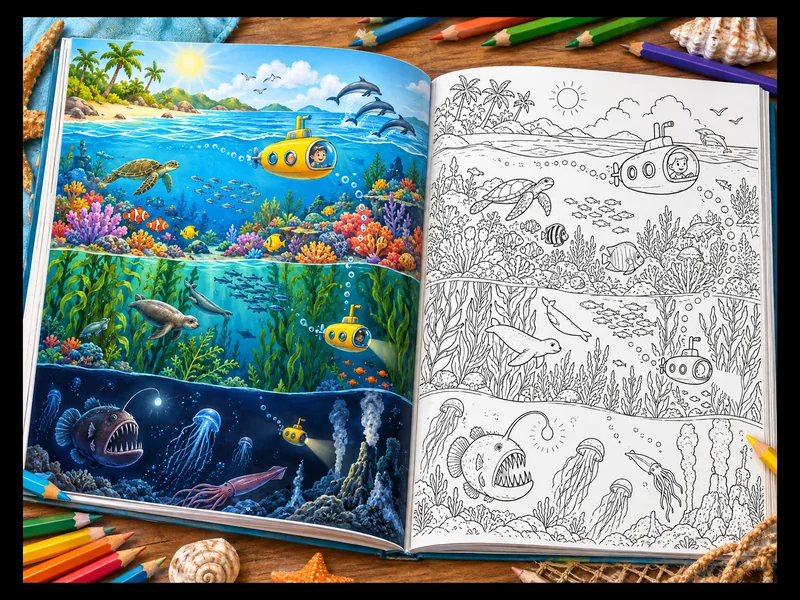
Quick answer: An ocean coloring book that moves habitat by habitat teaches more than one that shows random sea animals. Coloring an animal in its habitat helps kids notice how bodies and colors fit their surroundings, and each habitat gives new color clues, from bright reefs to dark deep-sea water.
Most ocean coloring books are collections of sea creatures. They're fun, but every page feels the same. A habitat-led book works differently. It takes kids from the shore to the reef, the kelp forest, the open ocean, the icy seas and the deep sea, so each section has its own look, its own animals and its own color palette. That difference turns coloring into exploring.
Why coloring by habitat works
- Place gives meaning. An animal makes more sense in its habitat.
- Contrast keeps interest. Bright reefs feel very different from dark deep-sea water.
- Structure builds a journey. Kids can track progress, one habitat at a time.
- Questions come naturally. "Why does this animal look like that here?"
Color clues for each habitat
Use these as prompts, not rules. Real animals vary a lot.
| Habitat | Color clues to explore |
|---|---|
| Shore and tide pools | Camouflage: browns, grays, greens and purples that match rocks. Sea stars and anemones can be brighter. |
| Coral reef | Lots of bright colors, used for hiding and for signaling. Ask: which colors help an animal hide, and which help it stand out? |
| Kelp forest | Kelp is brown and golden, not green. Sunlight filters through in gold and green tones. |
| Open ocean | Countershading: dark on top, light underneath. |
| Icy seas | Not everything is white. Water is blue-green, penguins are black and white (also countershading), and leopard seals have spots. |
| Deep sea | Many animals are red or black, because red light doesn't reach deep water. Add glowing lights in white or yellow. |
Questions to ask while they color
- Where does this animal live: near the surface or deep down?
- Is it hiding or showing off? How can you tell from the colors?
- What does it eat, and what eats it?
- What is its survival trick?
- If you moved it to a different habitat, what would go wrong?
Coloring tips
- Start with the animal, then color the habitat. Kids get to the fun part sooner.
- Use a scrap sheet behind the page if you use markers.
- Look at real photos from an aquarium or nature site, then compare with the colors you chose.
- Finish with a story. Ask your child to tell the story of the animal's day.
What to look for in an ocean coloring book
- Sections organized by habitat rather than random animals
- Accurate animals in the right habitat, with correct names
- Some story or activity pages, not only plates
- Fact panels using familiar units
- Line work that matches your child's coloring level (see our dinosaur coloring book checklist, which applies to any coloring book)
Keep exploring
- Learn about the animals in Ocean Animals for Kids: A Journey Through Six Habitats.
- Do the experiments in Ocean Activities for Kids.
About Rainy Sunday
Rainy Sunday Book Store creates imaginative coloring and activity books that pair curiosity with creative, screen-free time.