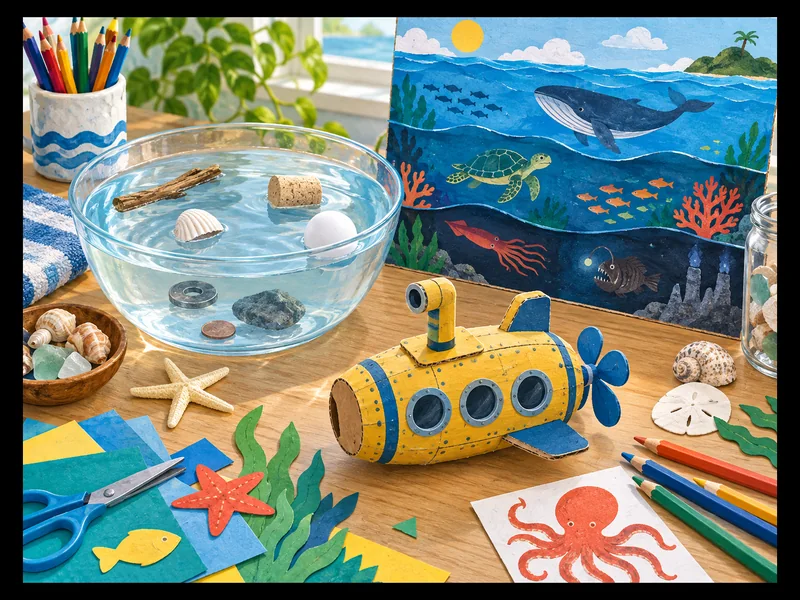
Quick answer: Eight easy ocean activities for kids: a habitat art strip, a sink-or-float test, a blubber glove experiment, a wave bottle, a camouflage fish, a deep-sea hide-and-seek game, a tide-pool sensory tray and a submarine story log. All use simple materials from around the house.
You don't need a boat to explore the ocean. These eight activities turn your kitchen table into a home ocean expedition. Each one links to a real ocean idea, so kids are learning while they play. Use them alongside our tour of six ocean habitats.
1. Habitat art strip
Time: 30 minutes | Mess: low
You need: a long strip of paper, crayons, watercolor paints, a brush.
Do it: Draw a wax-crayon picture of shore, reef, kelp forest, open ocean, icy sea and deep sea along the strip, going from left to right. Then paint watercolor over the top. The wax resists the paint, so the drawings pop out.
The science: Each habitat looks and feels different. Which one did your child make the darkest? The brightest?
2. Sink-or-float test
Time: 20 minutes | Mess: wet
You need: a large bowl or tub of water; items such as a cork, a coin, a rubber duck, a small rock, a piece of foil, a sponge, a plastic lid.
Do it: Predict whether each item will sink or float, then test. Reshape the foil into a boat and see how many coins it can carry.
The science: Buoyancy is the upward push of water. Ocean animals control it: many fish have a gas-filled organ called a swim bladder, and sea turtles and whales adjust it by changing how much air is in their lungs.
3. Blubber glove
Time: 15 minutes | Mess: medium
You need: two zip-top bags, a tub of vegetable shortening, a bowl of ice water, a towel.
Do it: Fill one bag with a thick layer of shortening. Place your hand inside a second bag, push it into the shortening-filled bag, and seal the edges. Put your "blubber" hand in one bowl of ice water and your bare hand in another. Compare how each feels after a short time.
The science: Blubber is a thick layer of fat that keeps polar animals warm in freezing water. The shortening works like blubber.
Safety: Keep hands in ice water for only short periods and stop if it hurts.
4. Ocean in a bottle
Time: 15 minutes | Mess: low
You need: a clear plastic bottle with a tight cap, water, blue food coloring, baby oil or cooking oil.
Do it: Fill the bottle about two-thirds with blue water, top up with oil, seal the cap tightly and tip the bottle side to side to make waves.
The science: Oil is lighter than water, so it floats on top. The rolling motion is like waves. Make sure the cap stays sealed, and don't drink the contents.
5. Camouflage fish
Time: 20 minutes | Mess: low
You need: paper, scissors, crayons or paint.
Do it: Cut out two paper fish. Color one dark on top and pale underneath. Color the other one solid bright. Hold each above your head, then look from below.
The science: Many open-ocean animals use countershading, dark on top and light underneath, so they blend in from above and from below.
6. Deep-sea hide-and-seek
Time: 15 minutes | Mess: none
You need: a dark room, a flashlight, small objects to hide.
Do it: Dim the room. One child is the anglerfish and holds the flashlight as a "lure." The rest are small fish who try to sneak past without being lit up. Swap roles.
The science: In the deep sea, many animals make their own light. The anglerfish's glowing lure attracts prey.
7. Tide-pool sensory tray
Time: 20 to 30 minutes | Mess: wet
You need: a shallow tray, water, smooth stones, a sponge, shells, toy sea creatures.
Do it: Fill the tray with a little water and arrange stones and shells as a tide pool. Pour water out to imitate low tide and back in for high tide, and watch which creatures are covered and which are exposed.
The science: Tide-pool animals live between wet and dry. Tides rise and fall twice a day.
Safety: Supervise young children around shells and small parts.
8. Submarine story log
Time: 30 minutes | Mess: none
You need: paper, a stapler or string, pencils.
Do it: Make a small "captain's log" booklet. Kids pick a habitat and record an imaginary dive: what they saw, what animals did, what surprised them. Use story starters like "Suddenly the lights flickered and…" or "Deep below the ice, we spotted…"
The science: Real scientists keep logs of what they observe. Writing down details makes kids look closer.
Keep the learning going
- Ask "why" questions. Why is the kelp forest brown? Why is the deep sea dark?
- Visit an aquarium, or watch a live camera from one.
- If you can, visit a tide pool at low tide and observe gently.
Keep exploring
- Take the tour in Ocean Animals for Kids: A Journey Through Six Habitats.
- See how coloring fits in: Ocean Coloring Book for Kids: Explore Six Habitats.
- Prefer dinosaurs? Try Dinosaur Activities for Kids.
About Rainy Sunday
Rainy Sunday Book Store creates imaginative coloring and activity books that pair curiosity with creative, screen-free time.